

Why I Started Building Guitars
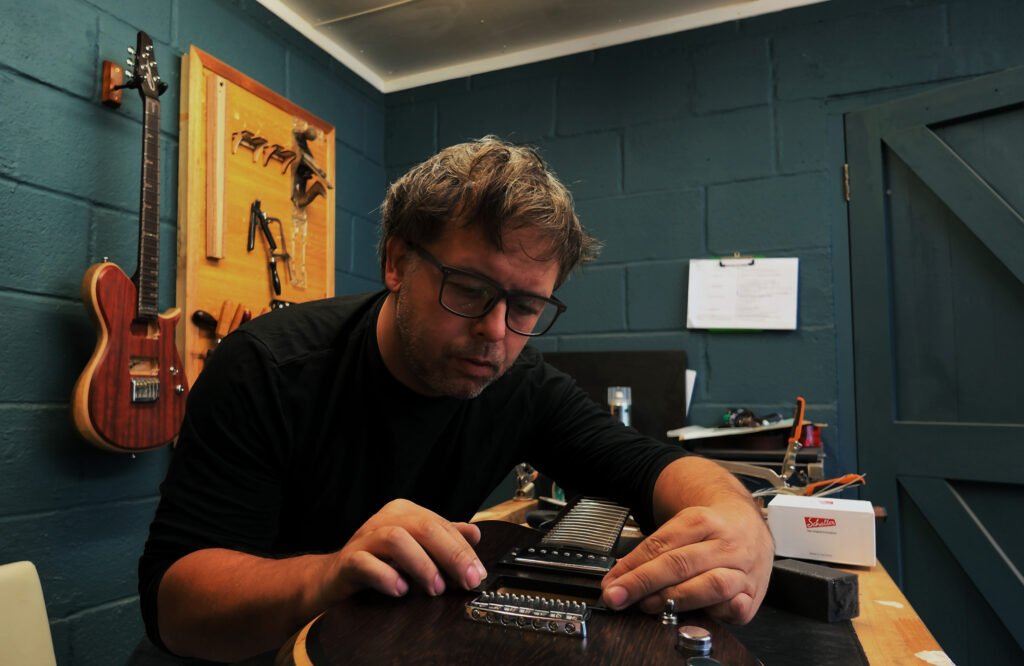
My journey into guitar lutherie began with an annoyance:
I couldn’t find the guitar I wanted to play.
The more I played, the more I questioned the design and construction choices of the guitars that the artists I loved seemed to speak so highly of, that I spent all my damn money on.
Rather than continuing to compromise, I decided to try designing and building one for myself. That has snowballed into a huge commitment, and a belief that I may have made something useful to others, I hope.
Thus here we have Evä.
What began as an attempt to solve my own frustrations has since developed into an instrument I really love, and hoping it is something stand-out and unique in a very noisy, crowded, diverse market.
The Design Concept & Progression
Musical Inspiration
Evä was heavily inspired by Symphonic Metal, a style of music that sits somewhere between the aggression, precision and power of modern metal and the dynamics, emotion and musical vocabulary of classical music.
That combination heavily influenced the way I approached the guitar. It also influenced the name, which has been lovingly stolen from a Nightwish song.
I wanted an instrument capable of handling the demands of technically demanding metal playing — fast passages, precise articulation and aggressive picking — while retaining a traditional look, and retaining as much beauty of the woods, as classical instruments do.
But I didn’t want Evä to become a guitar that was only suited to one genre.
The aim was to bring together classical and modern, traditional and progressive, precision and expression in a single instrument.
A guitar that could move comfortably from delicate, clean and expressive passages into heavy, aggressive playing without feeling like it was designed exclusively for one or the other.
In many ways, that became the underlying philosophy of Evä:
The best of both worlds.
The Original Concept
From the beginning, the goal was to create a guitar that felt fundamentally easy to play. I just wanted it to get out of the way and get on with it’s job reliably. Bridging the artist to music as much as possible, so all mistakes and incompetency can be blamed on the artist and not the tool (lolz).
The original concept was a single-cutaway guitar built around a few very specific principles: a slim and comfortable neck profile, 24 frets, and extreme upper-fret access from fret 1 all the way through to fret 24.
For the type of playing I wanted the instrument to accommodate, access to the upper register was particularly important.
I also wanted the instrument to feel relatively lightweight, balanced, both standing and sitting. Nothing should feel like it was fighting against the player. The guitar should sit naturally, feel effortless to hold, and allow the entire fingerboard to remain genuinely accessible.
The challenge was finding a way to achieve all of those things as best I can with a beautiful single cut design, without weighing a tonne, having a fragile headstock, jammy splayed string brake angles etc., if you know what I mean.
What Didn’t Work
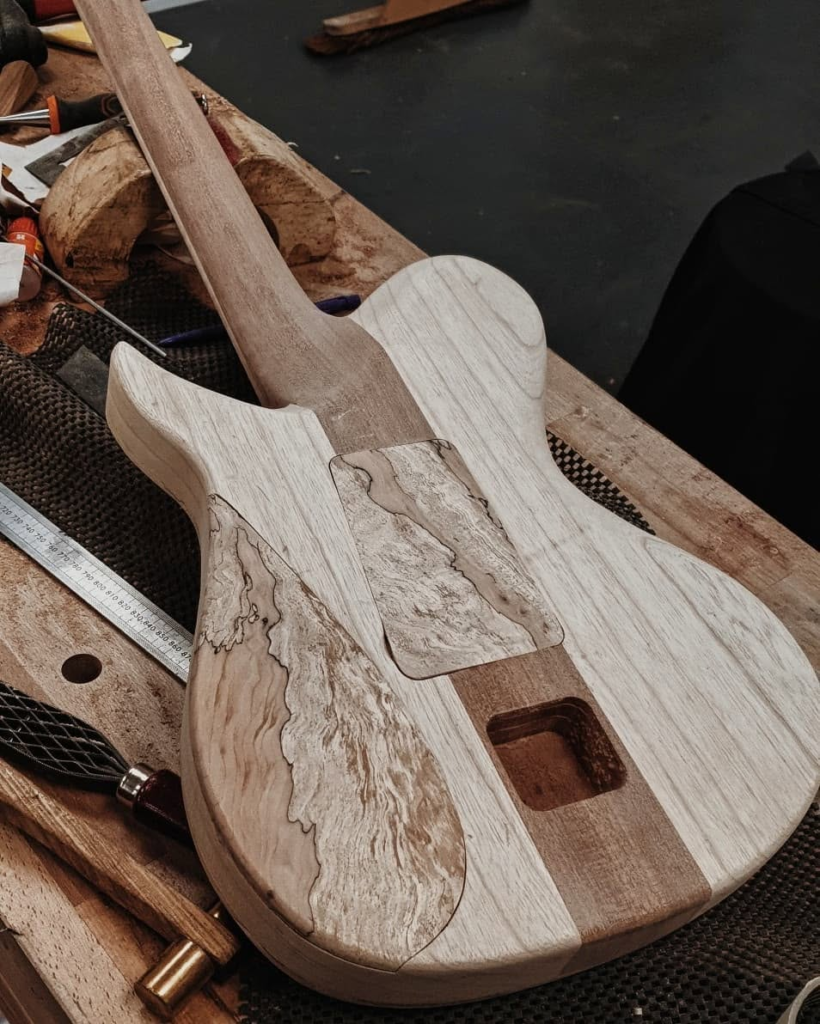
My first solution was a through-neck construction.
From a design perspective, it made sense. A through-neck allowed me to remove material around the heel almost without limitation, giving me the freedom to pursue the level of upper-fret access I wanted. In some early prototypes I may have gone too far.
But as my understanding of lutherie developed, I became less comfortable with the construction method itself.
The amount of material required to produce a through-neck, particularly when large sections are subsequently carved away, began to feel unnecessarily wasteful. I became much more interested in wood economy, resourcefulness and making better use of the material available to me.
So I went back to the drawing board.
The result was a move towards a set-neck construction.
The current design uses a set neck design maintaining the extreme upper-fret access that was one of the fundamental goals of the original concept.
The process isn’t necessarily finished, either. I’m interested in continuing to investigate whether a bolt-on construction could achieve the same level of access without compromising the ergonomics of the instrument. If it can, I’ll build it and find out. Next year’s problem.
Function Before Form — Without Sacrificing Beauty
The same evolution happened with the body.
My earliest cutaway and horn designs were still half-driven by aesthetics. I wanted the guitar to look right, and much of the design developed from that starting point.
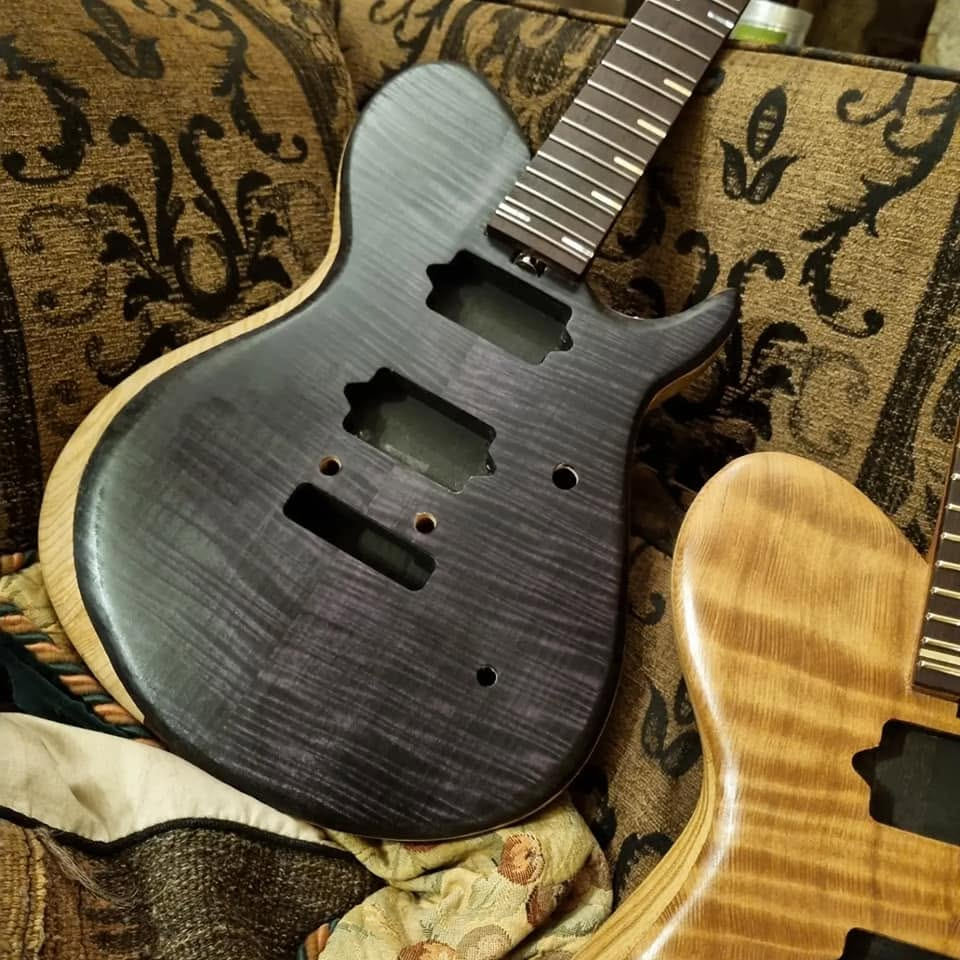
I became aware (with some feedback from a couple of other guitar players) of how the cutaway could interfere with the wrist and hand. So I started chopping big chunks out of it to see if it could make a surprisingly large difference to how naturally the instrument could be played.
The body shape and cutaway have therefore gone through repeated refinement, becoming less intrusive to the player while retaining the visual character that makes the instrument distinctive.
The Final Design
Evä is the result of a constant process of questioning, testing and refinement.
Every choice, shape, and accessory I’ve chosen has a purpose that I hope it fulfils. Some are there to improve playability, some to improve stability or versatility, some just to look nice, and some simply because after years of playing and building guitars, I’ve developed a very particular idea of what a guitar should feel like.
Ergonomics & Construction

Multi-Laminate Set Neck with Scarf Joint
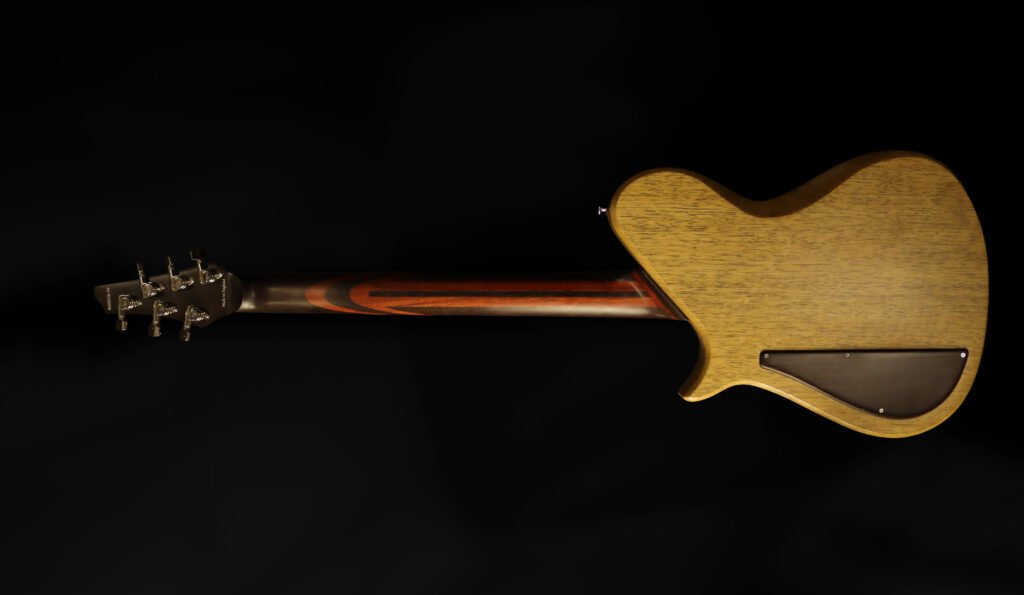
The neck is constructed from multiple laminated pieces of carefully selected timber, combined with a scarf joint.
Multi-laminate construction isn’t simply an aesthetic choice. By combining multiple sections of wood with carefully considered materials and grain orientation, the neck can achieve a high level of structural stability while allowing different woods to contribute their individual properties.
The laminations also create a visually distinctive neck that celebrates the construction rather than hiding it.
The scarf joint serves a similar philosophy of strength and efficiency. Rather than carving the headstock and neck from a single oversized piece of timber, the headstock is created from a separate section joined to the neck at an angle.
This allows the grain direction to follow the geometry of the neck and headstock more effectively, while dramatically reducing unnecessary material waste.
It’s a construction method that makes sense both structurally and from the perspective of responsible material use.
Extreme Upper-Fret Access
The entire neck has been designed around unrestricted access to all 24 frets.
The aim isn’t simply to make the 24th fret as reachable as the first. The transition into the upper register should remain natural and comfortable, without forcing the player’s wrist into an awkward position or requiring them to work around a bulky heel.
The result is a single-cutaway design that provides access right through to the 24th fret while retaining the visual character of a traditional single-cut instrument.

Ultra-Fast Neck
The neck is designed around a slim, fast-playing profile, targeting approximately 18mm at the first fret and 20mm at the 12th fret, with a carefully considered transition between the two.
Combined with 24 medium-jumbo stainless-steel frets, the intention is to create a neck that feels effortless for fast playing while remaining comfortable and substantial enough to avoid feeling fragile or insubstantial.
Perfect Balance
The entire instrument has been designed to feel lightweight, resonant and naturally balanced.
Whether sitting or standing, the guitar should remain where you put it rather than constantly trying to move itself.
This means considering the relationship between the body, neck, hardware and overall mass distribution as a complete system rather than designing each component in isolation.
Pickups & Electronics
Custom-Wound Pickups
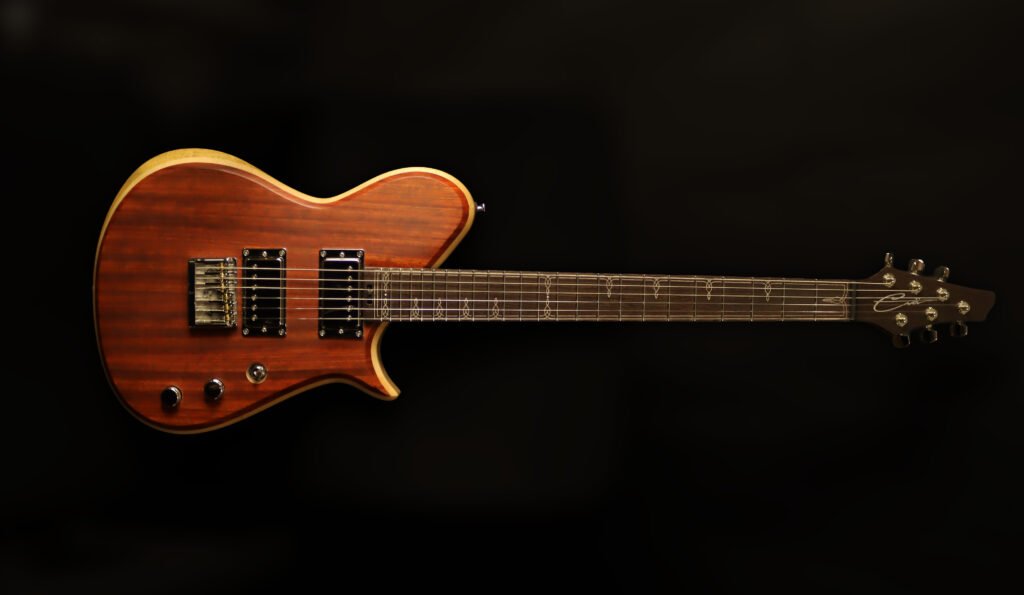
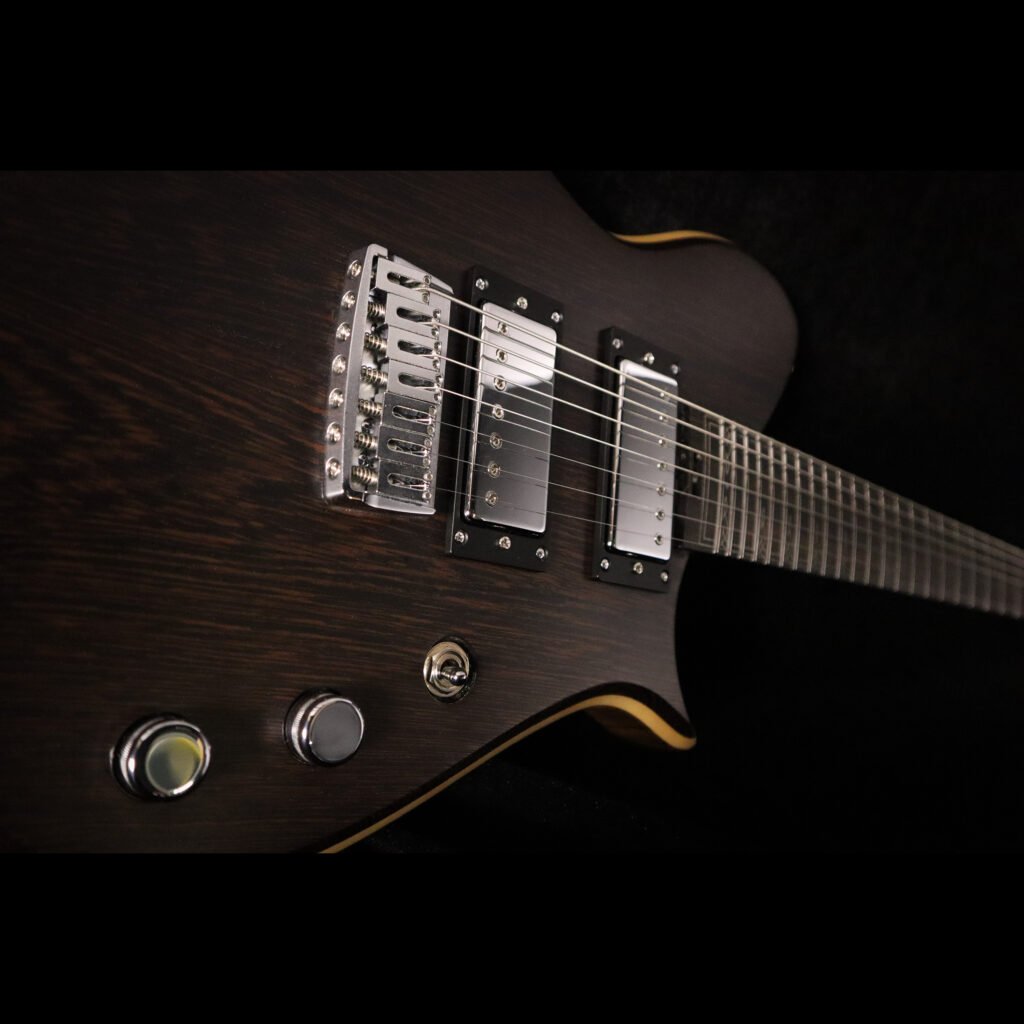
Evä uses a pair of custom-wound humbuckers by House Of Tone Pickups, designed specifically around the characteristics and requirements of the instrument.
The bridge pickup has been developed with focus on sensitivity to pick attack and greater dynamic range, allowing the player to move from controlled, articulate playing to aggressive attack without the sound simply becoming louder and harsher.
It’s voicing places more emphasis on the low-mid frequencies, giving the bridge position greater authority and presence in a mix while avoiding the brittle high end or excessive low-end muddiness that can sometimes accompany powerful bridge humbuckers.
The neck pickup combines warmer high frequencies with a more open midrange, aiming to bridge the gap between the smooth, familiar character associated with traditional neck humbuckers and the clarity and articulation expected from a more modern instrument.
The two pickups are therefore designed not simply to sound good individually, but to provide complementary voices across the instrument.

Hardware
The hardware on Evä is selected with the same philosophy as the rest of the instrument: function first, with no unnecessary compromise.
Schaller 3D-6 Hardtail Bridge — 6 String

For the six-string version of Evä, I currenty use the Schaller 3D-6 hardtail bridge.
The 3D-6 is an extremely versatile bridge, offering independent adjustment of string height, intonation and string spacing.
Its roller saddles allow the strings to move smoothly across the bridge, reducing friction and helping to minimise unnecessary string breakage during bending or changes in tension.
The string spacing can also be individually adjusted, allowing the bridge to be precisely matched to the neck and player’s requirements. The adjustable string radius provides further control over the relationship between the bridge and fingerboard.
The saddles use uncoated Pure Sound brass, providing a solid mechanical connection between the strings and bridge while contributing to the overall response and sustain of the instrument.
For Evä, the appeal of the 3D-6 is its combination of precision, adjustability and mechanical simplicity. It allows the final setup of the instrument to be refined at the bridge rather than forcing the design to accommodate fixed dimensions.
Gotoh 510FX-7 — 7 String
The seven-string version uses the Gotoh 510FX-7, a fixed bridge designed specifically for seven-string guitars.
The 510FX-7 combines a precision-machined construction with individual saddles for accurate intonation adjustment, providing a stable and rigid platform for transferring string energy into the instrument.
Its fixed construction provides a direct and stable connection to the body while allowing accurate individual string intonation.
For a seven-string instrument, maintaining a consistent relationship between the additional low string, the bridge and the rest of the instrument is particularly important.
The 510FX-7 provides the precision and rigidity required without adding unnecessary complexity.
Schaller M6 Locking Tuners
At the headstock, Evä uses Schaller M6 Locking Tuners.
The M6 combines Schaller’s established tuner design with a high-ratio gear system for precise and smooth tuning.
The locking mechanism allows the string to be secured directly at the tuner, reducing the amount of excess string that needs to be wound around the post. This makes restringing considerably quicker while reducing one potential source of tuning instability.
The result is a tuner that provides precision, reliability and practicality without unnecessary complication.
The Philosophy Behind Evä
Evä isn’t intended to be a collection of exotic specifications.
Every part of the design comes from a question.
Can this be more comfortable?
Can this be stronger?
Can this be made with less waste?
Can this be more reliable?
Can traditional construction be improved without losing what makes it beautiful?
Sometimes the answer has been yes.
Sometimes it has been no.
And some of the most important developments in Evä have come from discovering that an idea I originally thought was right simply wasn’t.
That process is still ongoing.
Evä is therefore less a finished product than the current point in an ongoing exploration of guitar design. As my playing, building and understanding continue to develop, so will the instrument.
Because ultimately, I’m not interested in building a guitar simply because that’s the way guitars have always been built.
I’m interested in finding out how good a guitar can actually be.